May 14, 2026
The Systems Behind Customer-Focused Businesses
The Importance of Customer-Centric Systems
Every successful business shares one common trait: it understands its customers. In today’s digital world, customers expect fast responses, personalized interactions, and consistent experiences across every touchpoint. Whether they are sending an email, making a purchase, or requesting support, customers want to feel recognized and valued.
As businesses grow, however, managing these interactions becomes increasingly complex. Conversations happen across emails, phone calls, websites, and social platforms. Without the right systems in place, important information gets lost, responses slow down, and customer experience suffers.
This article explores the systems that sit behind customer-focused businesses, how they help organizations manage customer information effectively, and why these systems are essential for efficiency, growth, and long-term success.
How Businesses Manage Customer Information
At the heart of every customer-focused organization is data. Customer names, contact details, purchase history, preferences, and past interactions all play a role in shaping how businesses communicate and deliver value.
Many organizations start by managing this information manually using spreadsheets, emails, or individual notes. While this approach may work initially, it quickly becomes unreliable as the volume of customers increases. Data becomes scattered across tools, duplicated across files, or lost when employees change roles.
Without a centralized system, teams struggle to get a complete view of the customer. This lack of visibility leads to inconsistent communication, repeated questions, and missed opportunities, all of which negatively impact customer trust and business performance.
What Customer Management Systems Do
 Customer management systems are designed to solve these challenges by bringing all customer information into one place. They act as a single source of truth, allowing businesses to store, update, and access customer data easily.
Beyond data storage, these systems track every interaction a customer has with the business. Sales teams can see previous conversations, support agents understand past issues, and marketing teams tailor campaigns based on customer behavior. This shared visibility ensures that every team works with the same, up-to-date information.
By connecting departments and workflows, customer management systems improve coordination and reduce silos across the organization.
Business Value of Strong Customer Systems
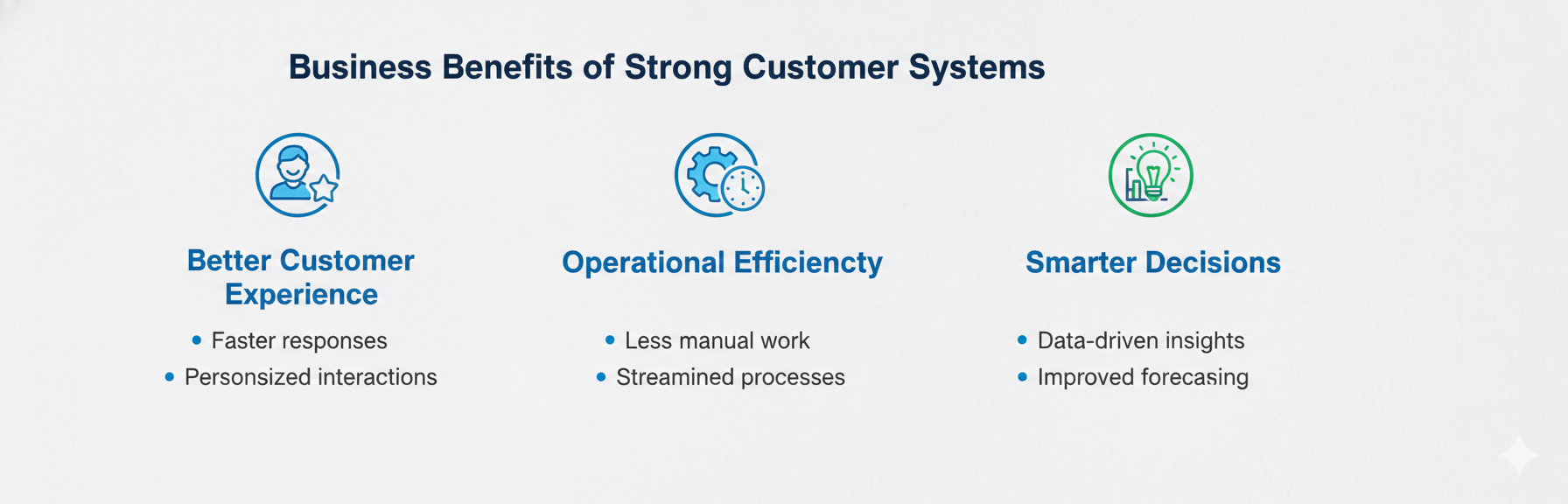 Strong customer systems deliver value across the entire business. With accurate and accessible data, teams can respond faster and provide more personalized service. Customers no longer need to repeat themselves, and interactions feel more seamless and human.
Efficiency also improves significantly. Automated workflows reduce repetitive tasks, freeing employees to focus on higher-value work. Managers gain clearer insights into performance, enabling better planning and more informed decision-making.
Over time, these improvements translate into stronger customer relationships, higher retention rates, and increased revenue.
Customer Systems in Practice with Modern Platforms
 Modern platforms such as Salesforce take customer management a step further by combining data, automation, and analytics into a single environment. These platforms eliminate data silos and ensure that customer information flows seamlessly across departments.
Automation plays a key role here. Routine tasks like follow-ups, case routing, and reporting can be handled automatically, reducing delays and errors. As a result, businesses save time, reduce operational costs, and improve overall productivity.
When customer systems are implemented correctly, they become strategic assets that support growth rather than administrative overhead.
Conclusion: Using Customer Systems to Drive Growth
Customer management systems are far more than digital databases. They are the foundation that allows businesses to deliver consistent, personalized, and efficient customer experiences at scale.
However, technology alone is not enough. To unlock real value, these systems must be implemented and customized to align with specific business goals and processes. This is where expertise matters.
As Salesforce partners, organizations help businesses design and optimize customer systems that save time, reduce costs, and drive revenue growth. When customer data is managed effectively, businesses are better positioned to build lasting relationships and succeed in an increasingly customer-driven marketplace.
Written by: Mishael Da’ap
Customer-focused businesses are built on connected systems, real-time data, and seamless experiences.
The right customer management strategy turns every interaction into an opportunity for growth.
Ready to operationalize Salesforce?
📩 bam@dkloudconsulting.com
📩 enquiries@dkloudconsulting.com
DKLOUD Consulting — Clarity. Scalability. Impact.